 Traderjoedex
: How LFJ Limit Orders Fill
LFJ, formerly Trader Joe, executes onchain limit orders when liquidity is available at the chosen buy or sell price. Available liquidity can support a full or partial fill, and the selected expiry ends further execution. A target price alone does not guarantee completion.
Price and liquidity requirements
LFJ's Aggregator monitors onchain liquidity across DEXs and AMMs for its limit orders. These orders draw on aggregated liquidity instead of matching bids and asks in a conventional order book.
The selected price controls when execution is possible, while liquidity available at that price determines how much can fill. A market price reaching the target does not establish that the entire requested size can trade there.
Execution outcomes
| Order outcome | Condition and consequence |
|---|---|
| Full fill before expiry | Liquidity at the set price covers the requested size, allowing the whole order to execute. |
| Partial fill before expiry | Liquidity at the set price covers only part of the requested size. That portion executes, leaving the rest unfilled. |
| Unfilled while active | Without available liquidity at the set price, execution cannot occur. The order remains subject to its price condition and expiry. |
| Expiry before execution | The order becomes ineligible for further execution. The user must manually claim funds from the unfilled expired order. |
Order entry and cancellation
Limit orders are available through a token's Terminal page on supported chains. Search, the homepage screener, and a watchlist provide alternative entry paths to that page. Tokens can be bought with supported native assets or stablecoins, or sold for those assets.
The order's terms include a buy or sell price and a user-selected expiry. LFJ also supports cancellation, providing a way to stop an order without waiting for expiry.
Filled output and fees
LFJ's platform fee schedule specifies a 1% fee for limit orders, charged at execution and deducted from the output tokens. Completed trades are sent automatically to the user's wallet with that fee deducted. The execution price and the net tokens received therefore need to be read separately.
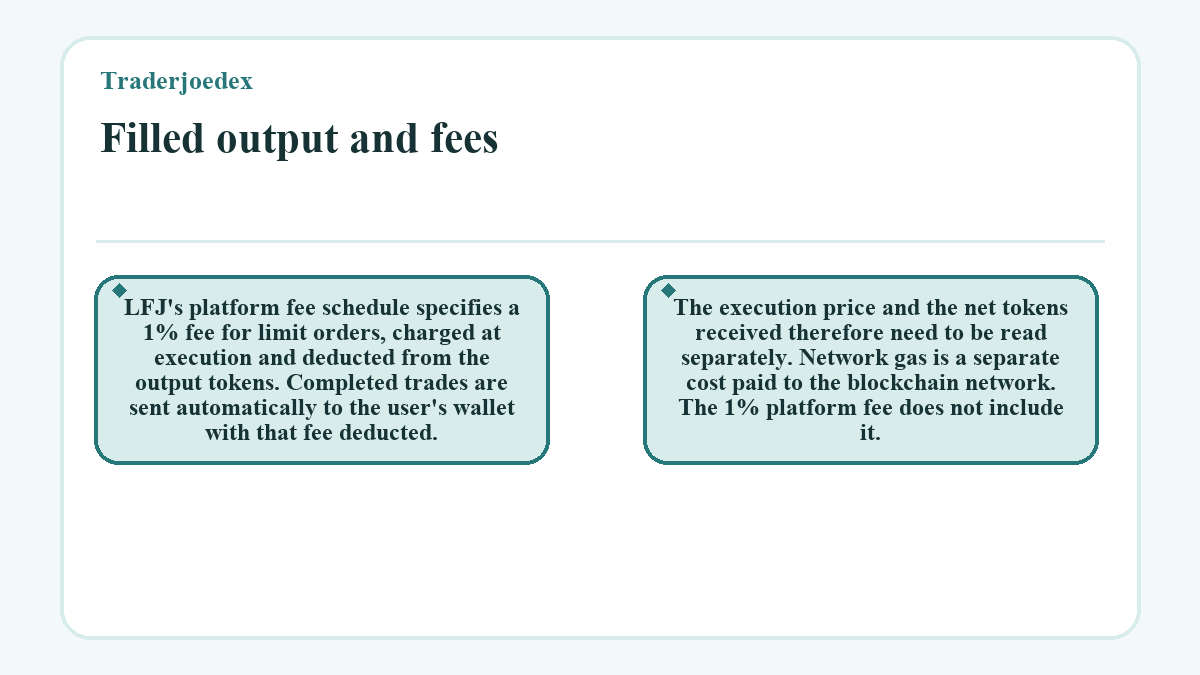
Network gas is a separate cost paid to the blockchain network. The 1% platform fee does not include it.